And if you are inspired to make something please email me a image at ruthraestudio@gmail.com and I will post it on the charming exchange blog.Friday, March 13, 2009
something fun to try out!
And if you are inspired to make something please email me a image at ruthraestudio@gmail.com and I will post it on the charming exchange blog.Thursday, March 12, 2009
book signing
Kelly Snelling and I will be signing copies of A Charming Exchange on Sunday, March 22nd, at 2:00 p.m. at The Garden of Beaden.

The Garden of Beaden is located in historic, downtown Upland, California at 313 N. Second Ave.

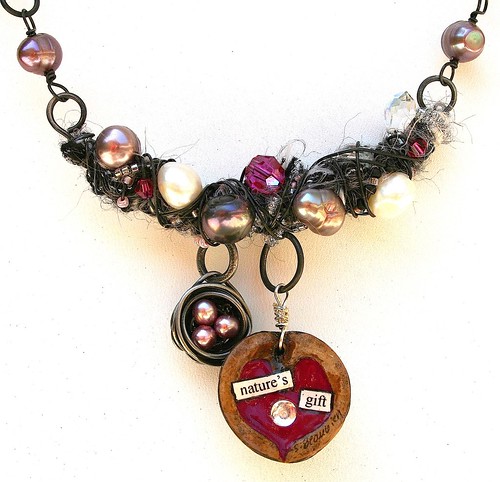
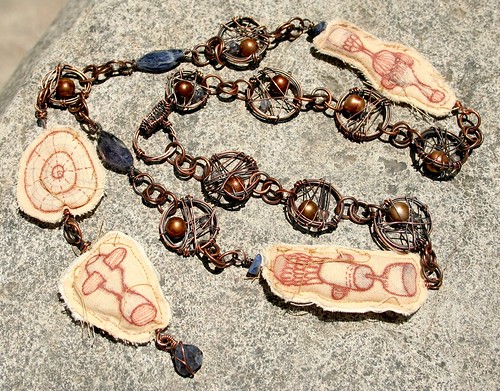
collaborators on this necklace from top to right are:
chain construction:Ruth Rae. bird nest charm: Deryn Mentock. natures gift: Shari Beaubien.
Kelly and I will also have jewelry and artwork for sale. And we will have pieces from the book on display for your viewing pleasure.

Chain construction: Ruth Rae. fabric charms: Jade Pegler
We will share the details on collaborations and demonstrate a few techniques from our book.

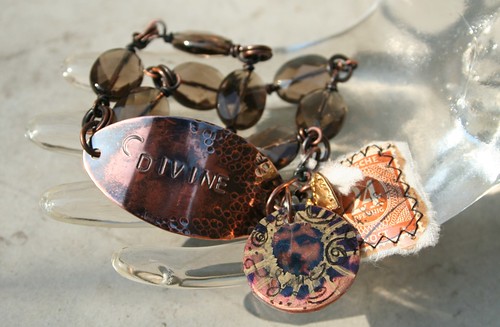
collaborators on this bracelet from top to right are:
Chain construction: Ruth Rae. divine:Deborah Edwards. man on the moon:Kelly Snelling. postage stamp:Judith Thibaut
Please come by and see us!
we are sure to have a divine time!
Chain construction: Ruth Rae. divine:Deborah Edwards. man on the moon:Kelly Snelling. postage stamp:Judith Thibaut
Please come by and see us!
we are sure to have a divine time!
Sunday, August 26, 2007
exciting update!
At long last the cover of the book!we got to see it last week for the first time!
our wounderful art director Marissa did one amazing job!
to pass your art to another artist and then have there spin put into is just what this book is about... sharing what you do the best with some one that has a different skill then you and then steeping back and allowing the process unfold.
I want to also congratulate my fellow cover girls from right to left:
Deryn, Catherine, Jess and Crystal!
If you have enjoyed the brilliant works created by the artists in the Simply Charming exchange, be sure to look for even more amazing artistry next spring. An Artful Exchange: connect create collaborate is a fabulous collaborative mixed media jewelry art book from the minds of Ruth Rae and Kelly Snelling bursting with the handiwork of many of the original artists from the Simply Charming exchange plus additional spectacular guests. available from North Light Publishing, Spring 2008! You can pre-order your copy today here.
Thursday, January 04, 2007
How it all Started
January 2006 started an amazing Calender Art Round Robbin project That I was part of it was headed by Kathy Wasilewski 24 artist made up 2 groups. Each month in the mail we received a different calender to work in. This project has just now come to an end in 2007. Those of us involved got to know one another through our art. I grew so much as a artist as each month came, I stretched a little each time just trying to keep up with all the amazing artist that came before me.
Through this amazement I wanted to create more with the group... this is how the Charm swap came to be.
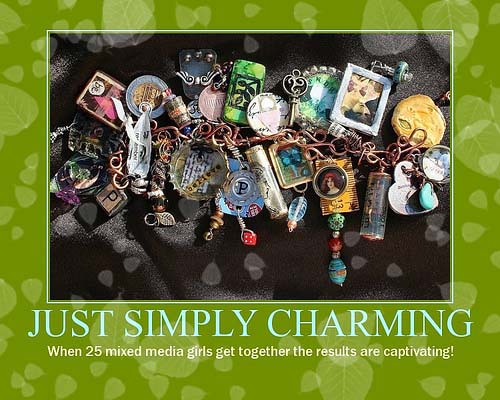
When I am involved in a group project I always long to know about the artist who's work I have received and how they created it, I asked each of the girls in this swap if they would send me a little blurb on the process of how they made there charms, I had intended on making up little how to books to send back to all them with there charms... then I realized just how mad I was... how was I going to create and assemble 20 of the bracelets and make 25 how to book!? then it dawned on me that I could create a blog as my gift to the group. This is how Just Simply Charming Blog came to be.
Please enjoy The work of 24 amazing artist as they Share a little bit of there self's with all of you!
Through this amazement I wanted to create more with the group... this is how the Charm swap came to be.
When I am involved in a group project I always long to know about the artist who's work I have received and how they created it, I asked each of the girls in this swap if they would send me a little blurb on the process of how they made there charms, I had intended on making up little how to books to send back to all them with there charms... then I realized just how mad I was... how was I going to create and assemble 20 of the bracelets and make 25 how to book!? then it dawned on me that I could create a blog as my gift to the group. This is how Just Simply Charming Blog came to be.
Please enjoy The work of 24 amazing artist as they Share a little bit of there self's with all of you!
Charm Swap Hostess: Ruth Rae

Ruth Rae
I wanted to do something easy because I was going to be making 21 of the 25 charm bracelets but after posting my how to's I see that maybe it was not so easy :)
please note that etching is a trial and era thing ... it does not always work and it does take some practice and the chemicals are hazardous and do require special handling.
MATERIALS:
* "Etchant" (ferric chloride)
* liver of sulphur
* black stazon ink for resist
* copper hearts
* glass or plastic container with lid,
big enough to hold piece of metal
* baking soda (bicarbonate of soda)
* fine sand paper, superfine steel wool, or brass brush
* methyl hydrate or isopropyl alcohol
* rubber gloves, plastic tweezers
1. Clean metal to be etched. Should be grease free with no scratches. Final finish should have a slight tooth (ink seems to adhere better than to a highly polished surface), but scratches which are too deep allow the Etchant to get underneath the ink and lift the ink off the surface. An ideal finish is achieved by rubbing with wet 600 Wet & Dry paper (emery or corundum) or scrubbing with wire brush, or superfine steel wool. Scour in a circular motion and rinse under clean water. Surface must be very clean and grease-free.
2. I used rubber stamps and black stazon ink for resist. Where you put ink it will resist the etching action of the chemical. Areas that are left free of ink will etch. The inked areas will remain in relief. remember the DESIGN WILL BE REVERSED. This is important if you are using letters or numbers. Remember to reverse the design. Hold design up to a mirror to check everything is the right way around. allow ink to dry for about 20 minutes.
3. Put etchant in glass or plastic container. Read the label for safety precautions. Submerge piece into Etchant with the design facing down (to allow particles of copper to fall away and not interfere with the etching process). It is best to suspend the piece in the solution, so it is clear of the bottom of the container. Either hang the piece from a wire strung across the container Agitate the solution frequently by gently knocking the edge of the container.
Depending on how much you have used the solution, the piece will be ready in 30 minutes (for new solution) to up to 2 hours (old solution, used many times). For quick action, do not dilute the solution.
4. IMPORTANT: When the piece is etched to the desired depth, remove the piece and wash immediately with water and scrub with an old toothbrush or brass brush and baking soda (or ammonia solution). The baking soda will neutralize the Etchant and stop the etching action. If the Etchant is not completely neutralized, it will continue its etching action.
5. antique with liver of sulphur
Deryn Mentock

Deryn Mentock
Making these charms, I was inspired by Susan Lenart's fabulous mixed media jewelry. I used Christmas light bulbs for the main element of the charm. I removed the plastic top on the bulb and wrapped the tiny bulb wires around a piece of 22 gauge copper wire. I wrapped the copper wire around the top of the bulb, making sure the tiny bulb wires stayed in place, and made a loop at the top. Next, I aged the charms by dipping the wire wrapped tops in a liver of sulpher solution then polished with 0000 steel wool and a polishing cloth. Last, a strip of text was applied with Glossy Accents which is a product that's similar to Diamond Glaze.
JoAnnA Pierotti


JoAnnA Pierotti
1. I started with an unused vintage bottle cap, removed the cork.
2. With a hammer I worked my way around slightly bending each side, forming almost a square.
3. Once each side was bent a bit, I then laid the cap onto some steel and pounded very hard until they became flat.
4. I then painted each one with black paint. When almost dry, I wiped some of the paint off.
5. I then hand painted a little rose on each. Let it dry and then poured tea colored walnut ink on charm, and hit it with my heat gun to give it an antique look.
6. Sealed them with a hard glaze.
7. Drilled holes and attached jump ring and strung some sterling silver beads dangling from the bottom.
Kelly Snelling


Kelly Snelling painted the underside of a beetle's wing with iridescent pearl paint. then she collaged on my grandmother's eyes and the word remember. she painted these over with a few coats of gel medium. lastly, she added a small bell and a jump ring. take flight!
Crystal Neubauer

Crystal Neubauer
If you'd like to try your hand at making a charm of your own, just follow the
instructions below.
Gather your supplies:
Glass vial with cork stopper (I've used antique watchmakers vials)
Pre 1909 image or text (must be this old to insure this technique will work)
Any craft varnish
Metal leaf adhesive
E600 or small amount of epoxy
Metal leaf
Wire, bobby pin, or paper clip
jump ring
Gather your tools:
Cup of water
Sewing needle
Jewelers needle nose pliers
Jewelers wire cutter
Thin paint brush
Dry paint brush with dense thick bristles
My work space tends to get very messy, so it helps to grab something to keep track of my smaller supplies. I like to pick up vintage mini muffin tins at estate sales:

Gather the images you will be working with & cut or tear around the section you will use for your charm:
You will need to thin the paper image for this project. This will give it a nice translucent quality and remove any text from the back. The type of paper used in pre-1909 books works well with this technique. After this date paper manufacturing changed. You can try a newer image but it may just turn to mush.
Dunk the paper in your cup of water and turn the image face down on a small piece of glass. As you begin gently rubbing with your finger, the paper will begin to pill and rub away. You will rub off any text on the back of your image and begin to see the image through the paper.
This is a real trial and error process, when you feel the paper has been thinned enough, stop rubbing and lay it on a paper towel to dry.
CAUTION! Just when you think you are almost there, you will rub a hole right through your precious image. I do this frequently. Practice Practice Practice before you try it on the image you want to use.
While your image is drying create the wire loop in the cork top for hanging.
Cut the top of an old bobby pin or paper clip or bend wire in a U shape. Press the ends into the top of the cork to create an indentation. Remove and use the sewing needle to pierce all the way through the cork at each indentation. Now push the U shaped wire, bobby pin, or paper clip all the way through until the ends are protuding from the bottom of the cork.
Use jewelers sized needle nose pliers to bend the wires at right angles and clip with wire cutters as necessary.
Curl the dry image around a nail and insert into the vial:

Thin your craft varnish with equal parts water. Only a few drops are necessary for one little charm like this. I tend to put a few drops on a flat surface and drop water off the end of my paint brush. Mix well.
Brush the reverse side of the image pressing it to the glass as you work. Be sure the paper is saturated, but do not use an excessive amount. Lay the vial on its side, image side down until it is dry. This may take an hour (good time to clean the work space or better yet, start another project!)
Next you will metal leaf the bottom of the vial. Brush the metal leaf adheasive over the outside bottom and around the bottom edge where you want the leaf to be. Remember this is glass and the adhesive may drip so use it sparingly.
Turn the vial upside down to dry. When the adhesive is clear it is ready.

Gold leafing is a lot of fun!
Stick the vial bottom side down on a sheet of leaf and press it around the edges where the adhesive has been applied. Using your stiff dry brush, brush off the excessive leaf. I like to brush it off over a cup or container in order to reuse the crumbs for another project.
Next insert the cork, securing with a glue such as E600 or a small amount of 2-part epoxy. Wipe any excess off after the cork has been inserted.
Now repeat the steps for the metal leafing around the top of the vial and the cork:
Your charm is ready for the jump ring. Enjoy!
Marci Glenn

Marci Glenn
Here is how I made these charms.
1. go to the bank and ask for new pennies
2. ask my husband to drill small holes at the top and bottom (while enduring the lecture that it is illegal to deface US money)
3. collect (or buy) gold and silver jump rings in different sizes
4. buy metallic “e” size beads (or any glass bead that will fit onto the jump ring)
5. open up jump ring and add a bead. Slide this jump ring through the top hole in the penny and close the ring. This will be the starter ring for the top.
6. make another one for the bottom. This will be the starter ring for the bottom.
7. Continue to make additional jump rings and beads. Add them to the top and bottom until you feel like you have enough.
8. Add one heavy duty jump ring to the top where the charm will attach to the bracelet.
9. Viola’.
Carla Naron's charms

Carla Naron
Round wooden disc, paint, text stamp, scrap papers and little charm (that is glued on back and used to hold jumpring.
Patty Van Dorin's charms


Patty Van Dorin used a gold toned frame as the base that I soldered to build it up. I then added collaged elements and folded the back edges over, soldered jump rings and added the beaded element. The paper collage areas are sealed with Diamond Glaze.
Sally Turlington

Sally Turlington
1. I saved the used 1" plastic cartridges from my husband's nicotine
replacement therapy supplies, removed the foil end covers and cleaned
them leaving the printed symbols and words.
2. I attached a five inch coil of copper wire to the top of the
cartridge.
3. From the copper sheet, I cut a rectangle small enough to pass
through the cartridge and hammered each participant's initials into the
rectangle.
4. I made the copper rectangle into a dangle for the inside of the
cartridge with copper wire, copper jump rings, and a bead. The bead is
on a jump ring and attached through a hole in the bottom of the tiny
copper rectangle. To finish the dangle, I made a connector with a four
inch copper wire by forming a ring at the bottom end of the wire and
attached it through a hole in the top of the copper rectangle.
5. I threaded the dangle through the cartridge by inserting the top of
the wire through the center hole of the copper coil on top of the
cartridge. With the remaining wire coming out of the top of the
cartridge, I fashioned a ring and wrapped the ends back around the wire
until it was flush with the top of the charm. Now the dangle was inside
the cartridge and able to swing freely from the top.
6. Finally, I made another five inch copper wire coil and attached it
to the bottom of the cartridge.
Jennifer Rowland

Jennifer Rowland
1. Select coin for charm. Punch a small (1.6mm) hole in coin using Metal hole punch.
2. Take 3” piece of silver wire and roll a tiny loop on each end of the wire, rolling the wire in opposite directions.
3. Take the 14 gauge piece of copper and thread into the loop to test the fit of the copper within the silver loop. The loop should fit very snugly around the copper wire. You should have to gently twist the wire back and forth to get it to pass through the hole. Repeat on opposite loop. This step is very important in making a strong rivet on the coin.
4. Once you have determined that the hole of the spiral is the correct size, spiral each end of the wire spiraling the wire in opposite directions.
5. Using round nose pliers place the coiled wire on the pliers and fold the coil in half, making a ‘cuff’ for your coin. Line up the hole in the center of the coil, one on top of the other. Leave space to insert your coin.
6. Slip the silver cuff on the coin, line up spiral holes with hole in coin and insert 14 gauge copper. Trim copper within 1/16” on each side of coin.
7. Gently, using chasing hammer, tap on copper wire in a circular motion, creating a mushroom shaped head on each side of the wire. This will hold your cuff on the coin. Continue working until there are no more rough edges on the copper and the cuff is securely fastened to the coin. It should not move or wiggle at all. Take care not to hammer the silver spiral. Take your time with this step.
8. Choose a word or phrase to stamp on the copper washer with metal stamps.
9. Place one end of small chain on jump ring, thread on washer, place other end of chain on jump ring making a loop. Place jump ring on coin charm.
10. Attach jump ring to charm and add to bracelet or necklace.
Note: I learned this technique at my local bead store, Nomadic Notions, Austin, Texas.
Trudy McLauchlan

Trudy McLauchlan's
TRUDY McLAUCHLAN's charm began it's life as a collaged Artist
Trading Card measuring 2.5 x 3.5 inches. The card was part of a
swap with the Theme "Dream Time" (and who hasn't dreamt of flying
with gorgeous butterfly wings?) for the 2005 Melbourne Paperific
Expo.
Using a vintage page from a store catalogue, circa 1930s, Miss Leah
McKinley was proudly photographed due to her winning the judges 1st
Prize of Beautiful Bathing Girl Competition! This image was scanned
through the computer and reduced in size, given butterfly wings and
other paper collage elements.
To then transfer this ATC to charm size, again it was scanned and
reduced in size on the computer. Trudy then glued the image to a
shop-bought brass frame with loops either end. To give the charm a
glass-like finish a layer of Papier was applied to the top of the
collage.
After a fun and lengthy trip to the bead shop (you can't rush some
things!), two coloured beads were added to the bottom of each charm
to add a dangly, frivolous-type finish to the Bathing Girl Butterfly
charm. These beads were very fiddly to thread so Trudy enlisted the
help of some little fingers, daughters Zoe and Margot were part of
the making of these charms. And they think they're going to wear it
when it arrives in Oz!!
Edina Tien

Edina Tien
My charms are made from glass flower vase pebbles. The image is from a Teesha Moore collage sheet, and I digitally added the word “dream.” After printing out the images, I attached them to the pebbles which were then soldered. Detailed instructions below…
Supplies:
• rubbing alcohol or window cleaner
• glass flat-backed pebbles (from floral dept of craft store)
• images printed on paper
• dimensional adhesive (such as Diamond Glaze™)
• copper tape
• bone folder
• soldering supplies (flux, lead-free solder, soldering iron, etc.)
• jump rings
• baking soda
• water
• paper towels
• fine steel wool
Directions:
1. Clean glass pebbles with rubbing alcohol or window cleaner
2. Adhere pebbles to image with dimensional adhesive; allow to dry overnight, then cut away excess paper
3. Copper tape the back of the pebble; cut away excess tape
4. Copper tape around the edge, crimping down excess tape toward the back of the pebble
5. Burnish with bone folder to firmly secure copper tape to the glass
6. Solder and add jump ring
7. Use paper towel and mixture of baking soda and water to neutralize and wipe away excess fluxm then use damp and dry paper towels to wipe away residue
8. Polish with steel wool, then use damp and dry paper towels for a final cleaning
Shari Beaubien

Shari Beaubien
These little charms evolved simply because I didn't know how to solder! I wanted to create the look of a glass charm, housed inside of a frame. Sometimes necessity is the mother of invention. Here's what I came up with:
1. Stain watercolor paper with coffee. (Immerse paper in regular, brewed coffee for several seconds. Remove and allow to dry.)
2. Cut squares from stained watercolor paper, measuring 1" x 3/4".
3. Create a base for each piece of paper using polymer clay. Roll the clay thin and press the cut watercolor paper down into the clay. Trim around the edge, leaving a very thin margin of excess clay. Round the edges of the clay upward slightly around the paper to create a little tray. Bake according to manufacturer's instructions.
4. Once cool, create a mini-collage on the paper side. I used fabric, color copies, collage paper, paint, and permanent marker.
5. Fill the interior cavity of each charm with resin. Follow the manufacturer's instructions in order to eliminate air bubbles and cure completely.
6. Finish by spraying each side of the charm with a coat of gloss varnish. Once dry, drill a small hole at the top, add a jump ring, and tie with a pretty ribbon.
Kathy Wasilewski

Kathy Wasilewski
I have never been a jewelry-maker, thus this was the 1st time that I have ever created something along these lines. I went to my local bead store and found some 2-sided sterling silver faces and some brass "tags" that resembled a body. Thus, the idea of an angel was born! I was able to find some sterling silver beads that looked like wings, and some small round disks to act as a halo.

After adding patina to the brass tags, I decided that it needed just a little something more to add interest. Out came the dapping block, and I was able to add 3 small "bumps" to the base of the tag. Since the faces were two-sided, I wanted to add a little more finishing to the back of the charm, so I added some small rhinestones into the indentations that were made by the dapping block. Overall, I am quite pleased with the finished result. I just hope that they hold together!!
Liz Smith

Liz Smith
I love using recycled items in my work, so started with used bottle caps that i sanded down and aged using a rusting solution. then i cut circles from decorative paper using a circle punch and stamped mini tags with a text stamp using staz-on black ink. i attached eyelets to the tags and tied thread bows through them. i printed out the word "believe" on the computer and them assembled each mini-collage before gluing them into the bottle caps. i used resin (my first time using this stuff!!) on top of the assembled bottle cap collages to seal and protect them. to make the bead dangly, i drilled a hole in the bottom of each cap and then put a jump ring through it. i then strung beads onto a length of copper wire, twisting it as i went to secure them. then i just attached the beads to the jump ring and closed it! easy!!
Debra Cooper

Debra Cooper
How-to:
For fabric bead: wrap a small strip of fabric around a wooden or
metal skewer. While holding the fabric in place, wrap a stitched
strip of acrylic felt (kunin felt) over the fabric overlapping the
edges and pin in place. Heat fabrics with a heat gun until the felt
begins to melt and pieces of the under fabric show through. Let the
pin and bead cool before removing it from the skewer. You can then
cut the bead to size with scissors. To add more strength to the
fabric bead, wrap it in a 6 in. piece of thin gauge wire tucking the
ends into the fabric.
Add fabric and glass beads and metal charms to a 2 in. eye pin. Use
needle nose pliers to make another loop at the end of the pin to
dangle more beads or a charm. Add jump ring to the top of the charm
to finish.
Chris Young

Chris Young
"Face" Charm Instructions
What You Need: White shrink plastic, 2 inch round punch, dye inks
(colors - mustard, sepia, olive, and coffee), Diamond Glaze, face
rubber stamp, copper wire, miscellaneous beads, heat gun, small
paintbrush, and jewelry pliers.
What To Do: First punch 2 round circles from the white shrink
plastics, and shrink both pieces of plastic with the heat gun. On a
heat resistant surface, heat one piece of shrink plastic until it is
very soft and then immediately push the rubber stamp image into it
(pressing firmly). In a few seconds the plastic will cool and retain
the debossed image of the rubber stamp. Flip the debossed piece of
plastic face down on work surface and lay a 4 inch cut piece of copper
wire across plastic. Lay the second piece of plastic over the top of
the wire sandwiching it between the two pieces of plastic. Heat the
top piece of plastic (holding the heat gun right above the plastic)
until it becomes soft. Immediately push the rubber stamp image into
the plastic and press down firmly. The second piece of plastic will
retain the rubberstamp image and will bond to the first piece of
plastic with the wire in between. (The image on the first piece of
plastic that is face down will be protected enough to keep the
original face image.)
Put miscellaneous beads of your choice onto the wire and bend the wire
with the jewelry pliers. Make a loop at one end to connect to a
bracelet or necklace, and make a decorative swirl at the other end to
keep the bead from falling off.
Mix a small amount of Diamond Glaze with a drop of ink (making several
different colored puddles). Using a small paintbrush, paint the
ink-stained Diamond Glaze onto the surface of the shrink plastic. (It
is okay to let one color run into another color, but do not let the
colors become too muddy.) Let the piece dry and then flip it over and
paint the opposite side. When completely dry (usually several hours),
attach the charm to your bracelet or necklace with the loop you made
in the copper wire at the top of the piece.
Jerri Reimann

Jerri Reimann
I used pre-drilled mini dominos, colored them with Adrondack alchohol inks and a Krylon leafing pen, then stamped the leaf design with black Staz-On. (Leaf stamp is from RubberMoon.) I sealed the domino with Papier Paper Glaze. Then I ran copper wire thru the pre-drilled holes and wrapped the hanging loop. Added a bit more of the glaze to make sure the wire was secure and wouldn't move.
Lelainia N. LLoyd

Lelainia N. LLoyd
I have a fondness for old sewing ephemera and rulers. I created my
charm from a vintage articulated ruler. I had a friend's husband
help me cut the ruler with a dremel into 1/2 inch increments on the
1/2 inch lines so a number would show on each charm. Then I went
through my vintage button box and chose little buttons for each
charm and I added the word "sew" to each one. I used my Fiskers
paper drill to drill the hole for the jumpring. I am so pleased how
they turned out-they have that lovely homespun quality to them that
I love.
Katie Kendrick

Katie Kendrick
roll a tiny cork on a staz-on ink pad
run a hole down the middle of it
string a couple beads on a headpin, then run wire through the cork
add a couple more beads above cork - cut and loop the wire end.
glue a tiny strip of asian script paper around center of cork
paint over cork with bronze powder and diamond glaze
recoat with diamond glaze when dry
Dawn Supina

Dawn Supina
1. Squash bottle cap with hammer
2. Punch hole in it (a hammer & nail works) save these caps for later
3. Create the round artwork at about 3 inches in diameter
4. Reduce the size to about 1 inch diameter ~ to fit in the bottle cap on a printer (I hand-colored the art at this point)
5. Using a color photocopier, copy work at 100%
6. Cut out each "round" (or use a large hole punch)
7. Glue art on to bottle cap
8. Coat round with sealer (Plaid Outdoor Gloss Sealer); let dry thoroughly and repeat.
9. Squeeze glitter around the inside edge of the bottle cap 10. Hot glue small decoration on
11. Attach jump ring through hole in bottle cap
Cece Grimes

By Cece Grimes
I fell in love with these little tin lunch boxes at the Target dollar
section and when Ruth came up with this swap I knew that I had to use these.
I liked the pattern on the side, so I had to de-construct the lunch box. The
top comes off by bending the hinges, but I had to use a chisel and hammer to
break the rivets in the bottom. I cut the side piece so I had one long piece
of tin that I hammered flat with a rubber mallet. I folded a piece over,
hammered it flat, cut out the shape, punched 2 holes, set eyelets in the
holes. I used 18 gauge wire to wrap a loop at the top and 20 gauge wire to
add the dice bead at the bottom. I hammered small alphabet bottle caps flat
and glued each persons initial on a charm.
Carrie Avery

Carrie Edelmann Avery
Charm instructions:
supplies:
wooden letter tiles
3/8" copper foil tape
flux
solder
soldering iron
black patina
bone folder
jump rings
diamond glaze
Wrap the edges of a wooden tile with copper foil tape. Flux and solder over copper tape. Solder jump ring to the top of the wooden tile. Apply diamond glaze (or matte accents for a matte look) over the wooden tile, careful not to get it on the solder. This will protect the wood from the black patina. Apply black patina to the soldered piece.
Lou McCulloch

Lou McCulloch tells a little about her charms:
I wanted to make charms to match the copper bracelet they would hang on, so I looked for copper or rust-colored embellishments. I found one inch rust-metal hearts, but had to put a tiny whole with a drill at the top of each one. I had the glass leaf and flower beads on some fringe I had purchased, but didn't trust the floss that was used to string them. Instead, I took them apart and restrung each one with brown 'Silamide' waxed nylon beadstring. Each flower, stem and leaf was strung through from top to bottom, then bottom to top. Triple knots with a dot of 'Diamond ' glaze on each knot completed the beads. I attached small matte photos with the same glaze, to each side, and then cut around the edges to fit. Fine sandpaper was also used on the edges. Finally, I used metal paints, in greens and cream, to highlight the photos, and coated each side with Diamond glaze. The double aged brass rings were attached to the heart and then the hanging flowers were tied and knots enforced with the same dot of glue.
Fiona Mortimore


Fiona Mortimore
How I made the charm:
I began with a brass charm with a loop at the top and one at the
base. The top one would be used for a jumpring, to attach the charm
to the bracelet, and I thought the other one would look nice with
dangly bits on it! Having spent ages drooling at the bead shop, I
found some beautiful Murano glass beads from Italy, and just
couldn't walk past them, even though they were a little larger than
I wanted to buy! I attached them with tiger wire and crimps. For
the charm itself, I glued small collage images to the inside and
covered them with a matching size clear acrylic adhesive dome.
Wednesday, January 03, 2007
Making the Bracelet
As the hostess I made bracelets for 20 of the girls

WHAT YOU NEED:
• 16 gauge, dead soft, wire (you can get this at a hardware store)
• Flush or semi-flush wire cutters
• Round nose pliers
• Chain nose pliers
• Flat nose pliers
• Ruler
• wood dowel or bic pen
Thunder bird supply sells both wire and tools.
S-LINK
1. Flush cut 7 to 8 pieces of 16g gauge dead soft wire, 3 inches long.
2. Place the end of your wire at the back of your small round nose pliers. Grip your pliers firmly and roll your hand forward to create a P forum repeat on the other end but forum the P in the wrong direction.


3. At the back of your large round nose pliers grip your wire under one of the P roll to the center of the wire repeat on the other side.


A small recap of the steeps :)

MAKING THE JUMP RINGS
Wrap 20" of 16-gauge wire around a wood dowel that is 1/4" or less in diameter. Keep a tail in your non-wrapping hand so that you have something to hang onto.
Wrap away from your body and place the coils as close to each other as possible.
When you reach the end of the wire, reverse the direction of the dowel and wrap the tail onto the dowel. Remove the coil from the dowel. You can saw or flush cut your rings.


Now its time to attach the s-links to the open jump rings
open your jump ring then add two s-links then close the jump ring.

continue until you have the completed bracelet.
use the last S-link as your clasp by leaving the end open so it can attach to a closed jump ring.

WHAT YOU NEED:
• 16 gauge, dead soft, wire (you can get this at a hardware store)
• Flush or semi-flush wire cutters
• Round nose pliers
• Chain nose pliers
• Flat nose pliers
• Ruler
• wood dowel or bic pen
Thunder bird supply sells both wire and tools.
S-LINK
1. Flush cut 7 to 8 pieces of 16g gauge dead soft wire, 3 inches long.
2. Place the end of your wire at the back of your small round nose pliers. Grip your pliers firmly and roll your hand forward to create a P forum repeat on the other end but forum the P in the wrong direction.


3. At the back of your large round nose pliers grip your wire under one of the P roll to the center of the wire repeat on the other side.


A small recap of the steeps :)

MAKING THE JUMP RINGS
Wrap 20" of 16-gauge wire around a wood dowel that is 1/4" or less in diameter. Keep a tail in your non-wrapping hand so that you have something to hang onto.
Wrap away from your body and place the coils as close to each other as possible.
When you reach the end of the wire, reverse the direction of the dowel and wrap the tail onto the dowel. Remove the coil from the dowel. You can saw or flush cut your rings.

Now its time to attach the s-links to the open jump rings
open your jump ring then add two s-links then close the jump ring.
continue until you have the completed bracelet.
use the last S-link as your clasp by leaving the end open so it can attach to a closed jump ring.
Charm Bracelet with necklace converter
Tuesday, January 02, 2007
Monday, January 01, 2007
Subscribe to:
Posts (Atom)